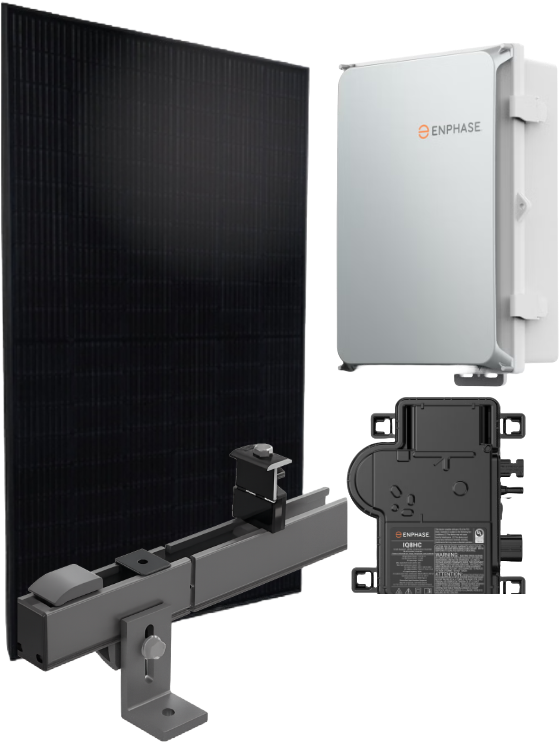
Home battery backup systems that automatically keep your lights, heat pump, and critical loads running during outages — no generator, no noise, no fuel. Zolotas handles the full electrical integration: panel, solar, and battery working together as a real system.
A home battery system is a large rechargeable battery installed alongside your electrical panel. During normal operation, it charges from your solar panels or the grid during off-peak hours. When the grid goes down, it automatically detects the outage — within milliseconds — and switches your home to battery power.
Unlike a generator, this switch is automatic and instant. There's no walking to the garage, no pulling a start cord, no waiting for warm-up. Your lights stay on. Your heat pump keeps running. You often won't notice the outage until you check your phone.
What It Covers — and What It Doesn't
Battery systems come in two configurations:
Essential load backup — powers selected critical circuits (lights, refrigerator, some outlets, internet). Most cost-effective starting point. Battery sized to last 8–16+ hours per charge.
Whole-home backup — powers everything in the house including HVAC, EV charger, range. Requires more battery capacity and careful panel design. Best combined with solar to recharge during an extended outage.
💡 The right sizing question: What do you actually need during an outage? Most families can keep comfortable and safe with an essential-load setup at significantly lower cost than a whole-home configuration. We help you answer this before recommending a system size.
Enphase IQ Battery — modular, stackable, and natively integrated with Enphase solar.
With vs. Without Battery
What an Outage Looks Like — With and Without a Battery
Essex County loses power during nor'easters, summer thunderstorms, and the occasional ice storm. Here's the real difference a battery makes:
❌ Without Battery
Lights out — find the flashlights
Heat pump shuts off — home starts cooling within hours
Refrigerator and freezer off — food at risk after 4 hours
Sump pump offline — basement flooding risk
No internet, no phone charging
Medical equipment unavailable
Solar panels also shut down (grid-tied systems)
✅ With Battery Backup
Automatic switchover in milliseconds — you may not notice
Heat pump continues — home stays comfortable
Refrigerator and freezer running
Sump pump protected
Internet, phone charging, lights all on
Medical equipment stays online
Solar recharges battery during daylight — extends backup indefinitely
Battery vs. Generator
Battery Storage vs. Generator — The Honest Comparison
Most Essex County homeowners thinking about backup power are comparing battery storage to a whole-house standby generator. Both work. Here's what you actually need to know to choose:
Factor
🔋 Battery System
⛽ Standby Generator
Response time
Milliseconds — automatic
10–30 seconds startup delay
Noise
Silent
65–75 dB (lawn mower level)
Ongoing fuel cost
None (charges from solar or grid)
Natural gas or propane — continuous
Maintenance
Minimal — software updates, annual check
Annual service, oil changes, test runs required
Outage duration
Limited by battery capacity — extended with solar
Unlimited while fuel supply lasts
Permits & installation
Electrical permit — clean, no gas line
Gas permit + electrical permit + concrete pad
Carbon emissions
Zero (especially with solar)
Combustion emissions during operation
Best for
Short to medium outages (hours to days), solar pairing, urban/suburban neighborhoods
Extended rural outages where solar isn't practical
Our honest take: For most Essex County homeowners — suburban lots, 1–3 day outages during storms — a battery system paired with solar is the better long-term choice. It's quieter, lower maintenance, and when combined with solar, it's effectively free to run. The generator wins only if you're worried about week-long outages or have a rural property with no viable solar.
Full-System Integration
Panel, Solar, and Battery Working Together
A battery doesn't exist in isolation. It connects to your electrical panel, and if you have solar, it connects to your solar system. Getting all three to work correctly requires someone who understands all three — not a solar company that subcontracts the electrical work and a separate electrician who's never dealt with battery interconnects.
Zolotas designs and installs the complete system:
Panel assessment — verify capacity and interconnect location before anything gets ordered
Panel upgrade in-house if needed — no separate contractor, no scheduling gaps
Enphase IQ Battery integrates natively with Enphase solar — seamless system management
Automatic transfer switch or load center — configured correctly for your backup goals
Solar + battery sizing matched to your actual outage protection needs
Commissioning and monitoring setup — you see battery state, solar production, grid status
Why this matters: We've seen battery installs where the electrician bolted the battery to the wall and called it done — no load management, no transfer switch configuration, no monitoring. It looks installed. It doesn't work right. A proper battery install is a system design job, not a box installation.
About Zolotas Electric
40 Years. Family-Owned. Essex County.
Zolotas Electric was founded by John Zolotas in 1984. His son Greg runs the company today — second-generation master electricians who've spent four decades wiring the homes of Essex County.
Battery storage is a whole-system project. It touches your main panel, your solar (if you have it), your critical load circuits, and your utility interconnect. We do all of it in-house, permitted, and inspected — and we're here if anything needs attention years later.
Want to Know If Battery Storage Is Right for Your Home? Get Your Free Electrification Guide
Answer 8 quick questions about your home — heating, solar, panel capacity, power reliability — and we'll send you a personalized roadmap showing which upgrades make the most sense for your specific situation.
Takes 2 minutes • No spam, ever
Ready to Add Backup Power?
Get a Free Battery Storage Consultation
We'll walk through your home, assess your panel and solar (if applicable), help you think through essential vs. whole-home backup, and give you a clear system design with real numbers. No pressure, no upsell.